

~The AI + Marketing Weekly~
what you need to know this week in ai + marketing (15-second version):
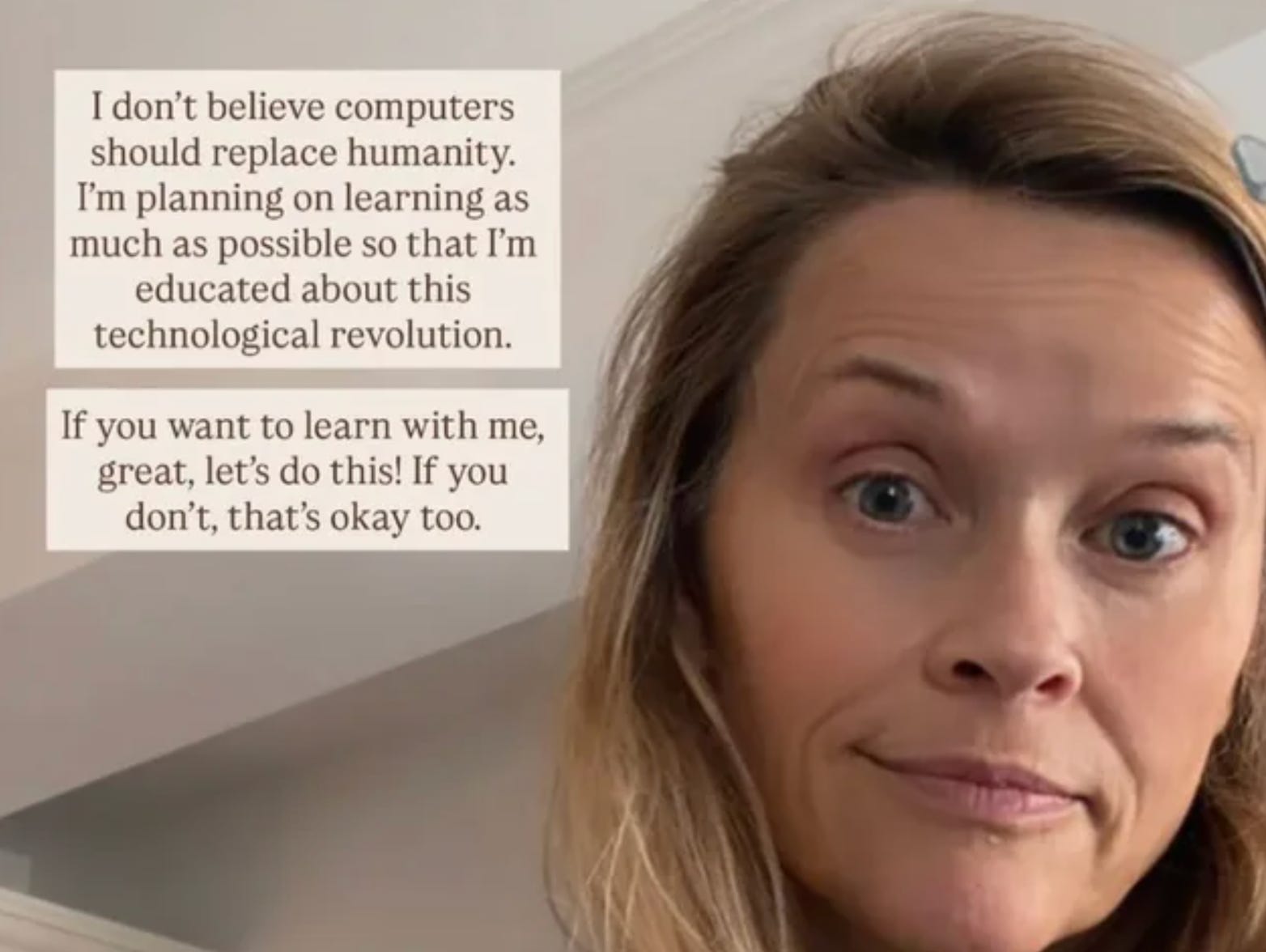
Reese Witherspoon asked 10 women in her book club how many used AI. Three did. Only one felt confident. - Nirnaya Lohani wrote about this on LinkedIn: “Discernment without literacy is an incomplete equation. You cannot shape what you do not understand.” The gap isn’t access, it’s confidence and literacy (Nirnaya Lohani)
Jena Wuu and Dr. Becky Kennedy on AI’s structural impact - Jena wrote that AI isn’t just technical, it reflects and magnifies structural gaps that already exist. Dr. Becky raised concerns about kids growing up with shortcuts for everything—struggle, boredom, and disappointment aren’t inefficiencies, they’re how kids build resilience. Adults need guardrails, not defaults (Jena Wuu / Dr. Becky Kennedy)
Big week for OpenAI with multiple product launches - GPT-5.5 (newest model for multi-step work), ChatGPT Workspace Agents (successor to custom GPTs for teams), and ChatGPT Images 2.0 (first image model with built-in reasoning). Rolling out across paid tiers (OpenAI)
The “bland tax” could erase your brand from AI search - Semrush’s CMO Andrew Warden at Adobe Summit: “If you are generic, you are average. And if you are average, you are invisible.” 60% of Google searches now end without a click (Search Engine Land)
Meta’s laying off 10% of its staff in May - 8,000 jobs gone May 20. Zuckerberg told investors work that used to need big teams can now be handled by one very talented person. Over 92,000 tech workers laid off so far this year (Business Insider)
Meta’s AI has been changing brand ads without permission - Snag Tights discovered Meta stretched grass into a patio in one of their ads. Even after disabling AI features, agencies report Meta re-enables them. CEO told Marketing Brew if the picture isn’t real, you’re basically scamming customers (Marketing Brew)
90% of CMOs experimenting with agentic AI but only 10% getting real value - McKinsey found the technology works but you have to rebuild your team around it. Most companies add AI agents to 2019 org charts and wonder why nothing changes (McKinsey)
🗞️ top ai + marketing news
the consumer pushback: trust, taste, and AI fatigue
The digital yawn: it’s not ad fatigue, it’s cultural exhaustion
The Drum | ~5-min read
Marketers blame ad fatigue when the real problem is repetition of bad creative. 85% of digital ads can’t hold attention for 2.5 seconds. AI tempts marketers to confuse output with effectiveness.
My take: People aren’t tuning out because they’ve seen your ad too many times. They’re tuning out because it was forgettable the first time.
You cannot trust a machine: the AI consumer perception survey
Vogue Business | ~7-min read
Vogue Business surveyed 251 readers across the UK, US, and Europe. 54% have never used AI for fashion shopping, 55% distrust AI recommendations, and 66% say an in-store AI robot would hurt their experience. Top concerns: loss of creativity (23%), job replacement (19%), and less human interaction (18%).
My take: The line that hit me: “Shopping with AI’s help is just boring.” Luxury consumers don’t want a chatbot, they want the thrill of discovery. AI’s best play in fashion is invisible - inventory, clienteling, behind the scenes - not a robot greeter.
Brand differentiation in the age of AI: creativity is marketing’s last real advantage
The Drum | ~5-min read
Data and personalization no longer differentiate. Qualtrics research across 354 brands shows emotionally connected customers are 5.7x more likely to trust a brand. Creativity is the only lever competitors can’t replicate.
My take: When everyone has the same tools, the only thing left is whether you have anything to actually say. Harder than another AI subscription.
search, discovery, and the bland tax
The hidden ‘bland tax’ that could erase your brand from AI search
Search Engine Land | ~5-min read
Semrush CMO Andrew Warden at Adobe Summit: AI is conditioning itself to ignore blandness. 60% of Google searches end without a click. Generic content gets summarized and stripped of attribution.
My take: “If you are generic, you are average. And if you are average, you are invisible.” Best line.
Why relevance now beats reach in the AI-driven buyer journey
MarTech | ~6-min read
All about how the buyer journey now starts with an AI-synthesized answer. New metrics: share of answers, shortlist presence, credible conversation. Subject matter experts are becoming content authors.
My take: Reach is on its way out. The new question is whether you make it into the answer at all.
the AI creative backlash + brand control
Meta’s AI push has made its way into ad creative.
Marketing Brew | ~5-min read
Snag Tights’ CEO told Marketing Brew that Meta’s AI quietly modified their ads, including stretching grass into a patio. Even after disabling AI features, agencies report Meta re-enables them. One called it “Whac-A-Mole.”
My take: When the platform changes your creative without permission, that’s a brand safety crisis…
Marketing strategists search for a solution to AI’s all-too predictable outputs
Digiday | ~6-min read
LLMs trend toward the average because they pick the most probable word sequences. Carnegie Mellon’s “NoveltyBench” found a “fundamental lack of distributional diversity” even with creative prompts.
My take: The sameness trap has a name now. If you’re using ChatGPT and Claude for everything, your strategy will look like everyone else’s.
the workforce reckoning
Meta plans to lay off 10% of its entire staff in May 2026
Business Insider | ~4-min read
8,000 jobs cut May 20, plus 6,000 open roles eliminated. Zuckerberg told investors “projects that used to require big teams now be accomplished by a single very talented person.” Over 92,000 tech workers laid off in 2026 so far. :/
My take: The Zuckerberg quote is the whole story. No more “rightsizing” euphemisms. They’re replacing teams with one person and a Claude subscription.
We need to talk more about AI’s impact on early-career marketers
MarTech | ~7-min read
Stanford found a 16% relative employment decline for ages 22-25 post-ChatGPT.
My take: This one hurts to read. The work we used to give junior marketers is exactly what AI does well. We need to figure out what their job actually is, fast.
the org chart problem
Reinventing marketing workflows with agentic AI
McKinsey | ~12-min read
Agentic AI could power 2/3 of marketing activities, with 10-30% revenue growth and 10-15x faster campaigns. Nearly 90% of CMOs are experimenting; fewer than 10% are capturing value end-to-end.
My take: The technology works, but you have to actually rebuild your team around it. Most companies will bolt agents onto a 2019 org chart and wonder why nothing changes.
Agile and non-agile marketing teams are stuck on 2 different AI problems
CMSWire | ~5-min read
Agile teams are 3x more likely to have AI fully integrated (39% vs 13%). Non-agile marketers worry about accuracy (still proving it works); agile marketers worry about governance (already scaling).
My take: It’s now all about whether your team can ship something imperfect and adjust.
the value frame: cost lever or growth catalyst
Marketing in the AI era: to matter more or cost less?
PwC | ~7-min read
PwC and the ANA found leading marketers deliver 79% greater shareholder value. Reinvesting AI savings into growth is 2x more profitable than savings-only.
My take: CMOs treating AI as a cost-cutting tool will bank one round of savings, then watch their growth shrink. The ones reinvesting in creative and testing keep compounding.
Adobe enterprise CMO explains how AI helps scale personalization
Business Insider | ~5-min read
Rachel Thornton, Adobe’s enterprise CMO: human creativity defines the brand, AI scales execution. She reframes AI as “augmented intelligence” and says CMOs must connect marketing to revenue or get treated as a cost center.
My take: “Augmented intelligence” is a soft framing but the substance is right. CMOs winning now show a direct line from marketing investment to revenue.
brand identity in the age of agents
When brands become actors
Fast Company | ~5-min read
David Placek of Lexicon Branding: brands have always been symbols, but AI turns them into actors. When your brand is embodied in a chatbot, it interacts, refuses, recommends, and corrects in real time. The challenge shifts from coordinating messages to governing behavior.
My take: Most brand guidelines cover static logos and tone of voice. Almost nobody has a doc on what their AI agent says. That’s the new brand voice and tone need!
👩💻 thought-leader highlights
Elena Verna – “Your product has a new user. It’s not human”
Elena argues that AI agents accessed via Model Context Protocol may become primary product users, ignoring UI and caring only about reliable output. Products relying on friction or complexity for defensibility face disruption. Distribution shifts from “getting users into products” to “making products fit into workflows,” with API reliability and documentation replacing traditional marketing.
Jonathan Martinez – “Day in the life of a Growth Engineer”
Jonathan describes how Growth Engineers build automated systems where AI agents continuously run tests, replacing manual marketing cycles. He advocates for centralized “context lakes” in GitHub rather than scattered Google Drives, and emphasizes building custom software solutions while training and orchestrating AI agents for tasks like competitor research and ad creation.
Marvin Chow – “Marketing Engineers are the hire of 2026”
Marvin defines marketing engineers as system architects who orchestrate AI solutions, not just tool operators. These professionals build systems that monitor brand mentions, track competitors, and update sales materials automatically. His hiring framework focuses on four competencies: mapping business processes, identifying where agents replace bottlenecks, building solutions, and measuring pipeline impact.
Amy Copadis – “Using Claude to build a content strategy for an affiliate site”
Amy demonstrates how she provided Claude with 10+ years of content marketing expertise to create audience research, style guides, and content strategy in an afternoon. She emphasizes that AI gets you “80% of the way” but human expertise is needed for the final 20% - analyzing results, requesting revisions, and making final edits.
Allie K. Miller – “AI hiring and onboarding guide for business problem solving”
Allie outlines a proficiency framework from Level 2 (surface users without impact) to Level 5 (full ownership of problems and solutions). New hires should start at Level 4, demonstrating critical thinking and understanding tradeoffs. She emphasizes that “using AI doesn’t replace your critical thinking—it means the work you can pull off now wasn’t on the table a year ago.”
Sarah Hoffman – “AI infrastructure and uneven adoption risks”
Sarah highlights that AI models are becoming foundational infrastructure shaping how work is done. Her central concern is that uneven development and adoption across sectors and demographics poses significant risks, potentially widening disparities rather than narrowing them. She emphasizes that who builds these systems matters for societal outcomes.
Marvin Chow – “How to future-proof your career in the age of AI”
Marvin writes that raw output will diminish in value while judgment and decision reliability become paramount. Success depends on sound judgment under uncertainty, strategic narrative crafting, and empathy-driven leadership. Future work emphasizes humanistic qualities over specialized technical skills, making liberal arts education and interdisciplinary synthesis increasingly valuable.
Svitlana Shuliak – “Boosting PMM efficiency with Claude and AI tools”
Svitlana shares how product marketers can develop reusable prompt templates for ICP definition, positioning, and battlecards. She advocates for advanced prompting techniques like role-playing and prompt chaining, integrating Claude with tools like Asana and Gong, and using different workspaces strategically—Chat for quick edits, Cowork for collaboration, and Projects for larger initiatives.
Anna Mason – “AI adoption spectrum: Maxxing, Anxious, Detoxing”
Anna identifies three AI adoption categories: Maxxing (aggressive adoption), Anxious (fear-driven use), and Detoxing (prioritizing real-world experiences). When she prompted ChatGPT to create an infographic, it produced gender-stereotyped output - a man as “AI Maxxing” and women as “Anxious” and “Detoxing”- demonstrating how implicit bias becomes embedded in AI systems.
Jena Wuu – "AI is a women's issue"
Jena writes that women's jobs are three times more likely than men's to be replaced by AI, particularly in administrative and operational roles. AI deployment occurs within existing systems that already disadvantage women through lower leadership representation and undervalued essential work. AI increasingly addresses underserved areas like women's health, yet women remain underrepresented in AI leadership decisions. Technology has long supplemented institutional failures, and understanding AI's trajectory requires recognizing how it reflects and amplifies existing societal inequalities.
Nirnaya Lohani – “Women’s AI literacy gap: A growing concern”
Nirnaya highlights that of 10 women in Reese Witherspoon’s book club, only 3 used AI and just 1 felt confident. A 2025 UN ILO report shows women’s jobs face nearly three times greater AI automation exposure than men’s. She argues “discernment without literacy is incomplete - you cannot shape what you do not understand,” and highlights accessible education initiatives like “AI-Empowered Mom.”
Dr. Becky Kennedy – “AI’s impact on child development”
Dr. Becky argues that children growing up with AI have constant workarounds for academic and emotional challenges, undermining development of critical skills like frustration tolerance and critical thinking. Kids naturally gravitate toward short-term comfort over long-term growth. She emphasizes that struggle, boredom, and disappointment aren’t inefficiencies - they’re necessary for building resilience. Society must create protective guardrails around AI access for children, with adults intentionally guiding use rather than letting technology lead by default.
🛠️ latest ai + marketing tools
GPT-5.5
OpenAI’s newest and most capable model, pitched as the next step toward its “super app” vision. Built for multi-step agentic work: coding, research, data analysis, and document creation with less user hand-holding. Rolling out to Plus, Pro, Business, and Enterprise subscribers in ChatGPT and Codex now.
ChatGPT Workspace Agents
OpenAI’s successor to custom GPTs, built for teams to create shared, always-on agents. Powered by Codex, agents handle complex workflows, connect to Slack, Salesforce, Google Workspace, and more, and keep working after you close your laptop. Free in research preview until May 6.
ChatGPT Images 2.0
OpenAI’s first image model with built-in reasoning, and a real upgrade for marketers. Generates up to eight coherent images from one prompt, renders multilingual text accurately, and outputs up to 2K resolution. Available to all ChatGPT users now.
Anthropic’s April 23 Postmortem
Anthropic publicly admitted three separate engineering changes degraded Claude Code’s quality for six weeks. The culprits: a reasoning effort downgrade, a caching bug that made Claude forget mid-session, and a verbosity cap that hurt coding output. All fixed as of April 20, with usage limits reset for all subscribers. Notable for the transparency.
Claude Code Desktop redesign
Anthropic redesigned the Claude Code desktop app with multi-session support and Routines for repeatable workflows. Landed the same week as Canva AI 2.0 and OpenAI’s Codex update, making it one of the bigger weeks for AI-native tools across the board.
Genspark AI
An all-in-one AI workspace that runs multiple models simultaneously and acts on tasks rather than just answering them. Covers slides, docs, sheets, web dev, meeting notes, and voice, plus an AI employee called Claw that executes multi-step tasks across tools. Hit $250M ARR in under a year with a team of about 30 people.
DOJO AI raises $6M
Agentic marketing platform that monitors campaigns around the clock and acts on what it finds. Built on a proprietary knowledge graph that models your brand’s full marketing operation. Serves CoinDesk, Morningstar, and PensionBee, with 20% month-on-month growth since launch.
Google Pomelli in Europe
Google’s AI-powered local discovery companion, now expanding to European markets. Helps users find local businesses, events, and places through conversational queries rather than keyword search. A signal of how AI is reshaping local and discovery marketing.
Adobe AI website experiment
Adobe is testing a tool that generates websites customized by generation and audience persona. Early testing focuses on Gen Z aesthetics, hinting at a future where brand sites auto-adapt to whoever’s visiting without manual audience segmentation in the design process.
Knak + AI agents
Enterprise email and landing page builder Knak is making its production capabilities callable by AI agents. Marketing teams can now trigger Knak workflows programmatically, meaning AI can plan and build campaigns without humans opening the tool. A quiet but meaningful step for enterprise marketing automation.
Omnicom’s influencer brand safety tool
Omnicom launched an agentic AI tool that automatically reviews and adjusts influencer content for brand safety. It monitors creator output, flags issues, and recommends edits in real time, addressing one of the persistent headaches in influencer marketing at scale.
Semrush brand visibility framework
Semrush introduced a new framework for measuring how brands appear in AI-generated search results. As ChatGPT, Perplexity, and Gemini reshape discovery, Semrush is betting marketers need entirely new metrics for this new channel.
Lovable Desktop app
The popular AI app builder launched a native Mac desktop app with local MCP server support and multi-project tabs. Lets builders connect local tools like Figma Desktop directly into Lovable without a browser. The company hit $200M ARR in its first year with 100,000 new projects built daily.
💼 cool ai + marketing jobs
Laurel - AI Ops, Marketing
Adobe - Campaign Content Manager, Applied AI
O Positiv Health - AI Creative Strategist
Ramp - Agentic Operator, Growth Marketing
Snowflake - Product Marketing Lead - AI Solutions
Reply anytime and let me know:
Topics you’d like covered in future weeks
Sections you love or could do without
Questions about AI, marketing, or anything else
Love y’all,
Carley
Another great issue! Thank you for the shout-out!
Your points about tech layoffs and impact on those in their early career really hit hard (disclaimer: I’m ex Meta). I think/hope we will figure it out (bc we have to!) but no doubt career paths are going to look very, very different for the next generations.