

~The AI + Marketing Weekly~
what you need to know this week in ai + marketing in 15 seconds:
The New Yorker published a deep profile on Sam Altman asking if he can be trusted to control our future - there’s a growing gap between how casually we use these tools and how much power sits behind them (The New Yorker)
Visible AI in marketing is more likely to hurt trust than help it - when consumers can tell AI made something, especially if it replaces human interaction, trust goes down. Most people don’t want a reminder that a machine made the thing they’re looking at (eMarketer)
Product feeds are now an organic strategy in AI search - AI-driven search pulls structured data directly into answers, so it’s less about pages ranking and more about whether your data is actually usable. If the data isn’t clean, you just don’t show up (Search Engine Land)
Anthropic’s most powerful model is too dangerous to release publicly - they’re only previewing Mythos to Apple, Microsoft, and Amazon because they’re worried it can find and exploit security flaws at scale. The project is called Glasswing (Anthropic)
Meta finally debuted its first proprietary model, Muse Spark - this is nine months and $14.3 billion after bringing in Scale AI’s Alexandr Wang. It’s free, multimodal, and rolling out across Facebook, Instagram, and WhatsApp to 3+ billion users (Meta)
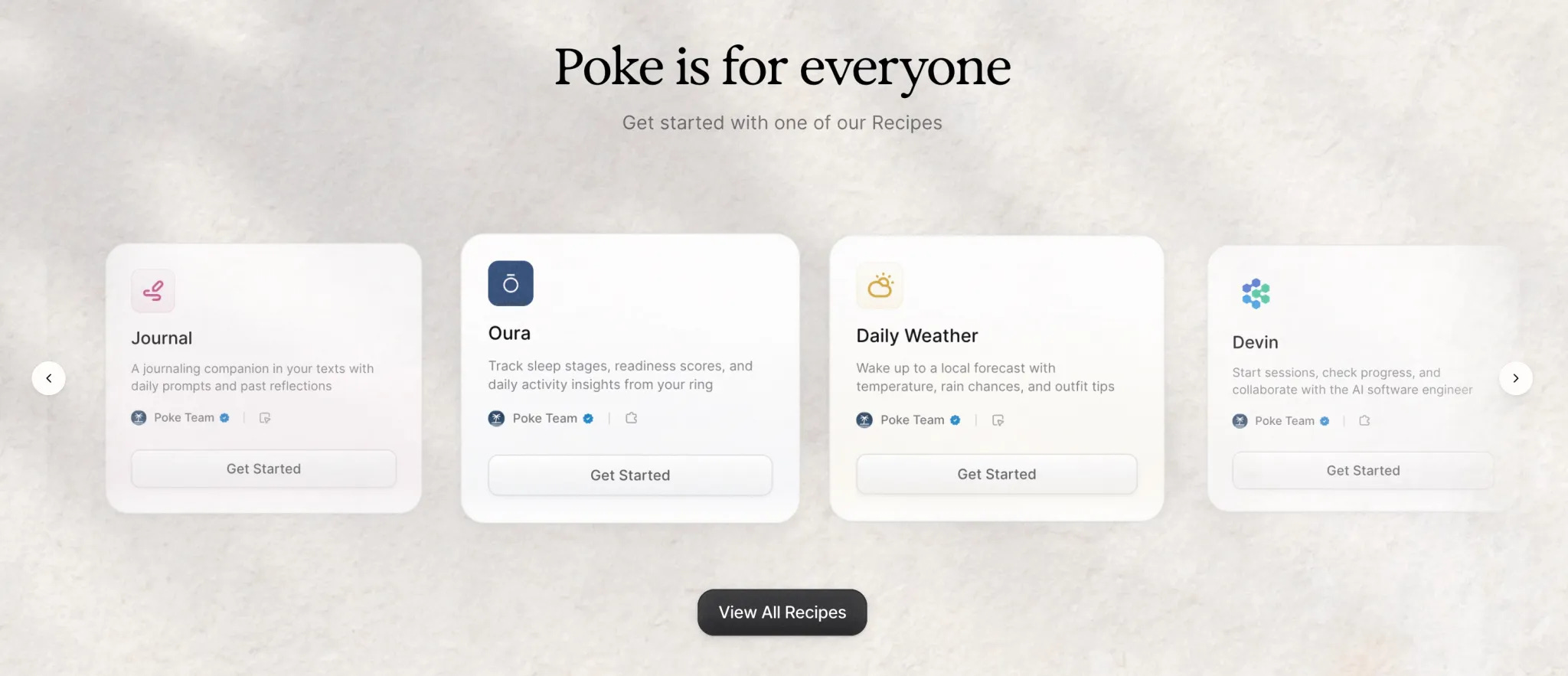
Poke is an AI agent you access through text message - works through iMessage, SMS, or Telegram with no app download. Handles your calendar, email monitoring, and smart home control through plain text. Backed by Spark Capital and valued at $300M (Poke)
Canva just acquired Simtheory and Ortto - they’re pushing hard from design tool to full-stack marketing OS. Calling it the “biggest evolution in Canva’s history” and teasing more at Canva Create on April 16 (Canva)
🗞️ top ai + marketing news
power, people, and who shapes AI
Inside Anthropic’s effort to give Claude a moral compass
The Washington Post | ~7-min read
Anthropic has been working with religious thinkers, including Christian groups, to shape how Claude responds to moral and ethical questions. The idea is to make the model more grounded in real-world value systems instead of purely abstract rules.
My take: This is one of those things that sounds strange until you think about it for a second. If AI is going to answer messy human questions, someone is going to influence how it does that.
Sam Altman may control our future. Can he be trusted?
The New Yorker | ~10-min read
A deep profile of Altman and OpenAI’s growing influence, looking at the tension between ambition, control, and public accountability as AI becomes more embedded in daily life.
My take: There’s a growing gap between how casually we use these tools and how much power sits behind them.
Amazon CEO Andy Jassy’s 2025 shareholder letter
About Amazon | ~8-min read
Jassy lays out Amazon’s AI strategy across AWS, advertising, logistics, and retail. The throughline is pretty simple: AI is being layered into everything, not treated as a separate bet.
My take: Amazon rarely overcomplicates its story. This reads like “we’re putting AI everywhere it can make money,” which is probably the most honest version of what most big companies are doing.
search, discovery, and the shift to AI-first
Why product feeds are now an organic strategy in AI search
Search Engine Land | ~5-min read
As AI-driven search pulls structured data directly into answers, product feeds are becoming a core part of organic visibility. It’s less about pages ranking and more about data being usable.
My take: This is SEO getting very literal. If the data isn’t clean, you just don’t show up.
FAQ: Agentic commerce and how brands should respond
eMarketer | ~5-min read
A practical breakdown of how AI agents are starting to handle product discovery and purchasing, and what brands need to change to stay competitive in that flow.
My take: The funnel is getting shorter, but also weirder. You’re not just convincing a person anymore.
ads, creative, and what’s actually working
Meta pushes further into AI-generated ad creation
Marketing Brew | ~4-min read
Meta is continuing to build tools that generate creative, targeting, and variations automatically. The goal is to make ad creation faster and more scalable directly inside the platform.
My take: Convenient, yes. Differentiated, less clear. If everyone’s using the same tools, the bar just shifts somewhere else.
Brands, agencies, and what they’ve learned marketing to AI systems
Fast Company | ~5-min read
CMOs and agencies are starting to think about AI systems as an audience of their own, which changes how content is structured, tagged, and distributed.
My take: It sounds dramatic, but it’s already happening. People search, AI answers, and brands have to fit into that answer somehow.
AI ads are everywhere. Consumers aren’t always into it
CBS News | ~5-min read
Coverage of how AI-generated ads are scaling quickly, along with the mixed reaction from consumers who sometimes find them off or untrustworthy.
My take: People don’t mind AI. They mind bad creative. A lot of AI ads just happen to be bad.
trust, authenticity, and the brand gap
Visible AI in marketing is more likely to hurt trust than help it
eMarketer | ~3-min read
Research shows that when AI use is obvious to consumers, it’s more likely to reduce trust than increase it, especially if it replaces human interaction or feels deceptive.
My take: This tracks. Most people don’t want a reminder that a machine made the thing they’re looking at.
AI might be the best opportunity we’ve had for authentic brand content
CMSWire | ~5-min read
The argument here is that as low-effort AI content floods the market, genuinely thoughtful, human work stands out more than it used to.
My take: The bar didn’t go up. The floor dropped. That’s a different kind of opportunity.
research, data, and what’s actually changing
Stanford AI Index Report 2026
Stanford HAI | ~12-min skim
A comprehensive look at AI adoption, investment, performance, and societal impact across industries. The big picture: usage is up, expectations are high, and the outcomes are uneven.
My take: These reports are useful mostly for the scale. Everyone is in it, but not everyone is getting the same results.
safety, risk, and the edge cases
Anthropic says its new model is a cybersecurity wake-up call
The New York Times | ~6-min read
Anthropic claims its latest model significantly raises the stakes for cybersecurity, with capabilities that could both strengthen defenses and increase risks if misused.
My take: Every capability story now comes with a second version of the same story, just flipped. More power, same pattern.
👩💻 thought-leader highlights
Shama Hyder - “Trust Is the AI Moat Nobody’s Talking About”
While AI commoditizes execution and access still matters, the scarcest resource in a world of infinite competent-looking content is whether people actually believe you.
Richard King - “Claude Has Six Layers. Most People Are Stuck on Layer One.”
A breakdown of Claude’s six layers (Chat, Projects, Cowork, Skills, Connectors, Code) for product marketers, arguing most of the real value sits beyond the basic chat window and takes about 10 minutes to unlock.
Ira Bodnar - “Connect Your Ad Accounts to Claude in 5 Minutes”
A step-by-step guide for connecting Google Ads, Meta Ads, and GA4 to Claude via MCP, with five specific audit prompts to immediately surface wasted spend and performance leaks.
Anisha Jain - “9 Free Fixes to Stop Burning Claude Credits”
Nine tactics (file compression, batching messages, switching models, editing vs. resending) to dramatically reduce token usage without upgrading to a paid plan.
Claire Roberts - “Sam Altman Just Confirmed Social Media Is Broken” Altman’s recent blog post effectively admitted social media algorithms are “misaligned AI” designed to override users’ long-term interests, and Roberts argues regulators can no longer claim ambiguity when the builders themselves are confirming the harm.
Michael Leibovich - “Claude Code Gave Me an Always-On Chief of Staff”
A senior Adobe leader shares how Claude Code + Obsidian + Earmark replaced a generic AI setup with one that reflects his own experience and pattern recognition, arguing it’s a clarity exercise, not a technical one.
Michael Crist - “The Non-Technical Person’s Complete Guide to Claude Code”
A CEO who can’t write code walks through installing and using Claude Code from scratch, covering email integration, building dashboards from spreadsheets, and why context-building matters more than prompting.
Julie Austin - “AI Isn’t Cheating. It’s Just the Latest Thing Women Need to Stop Feeling Guilty About.”
The gap in women’s AI adoption isn’t about tech fear but imposter syndrome and the belief that if something makes work easier, you haven’t earned it. Using AI for efficiency is common sense, not a moral failure.
🛠️ latest ai + marketing tools
Meta’s AI finally shows up
Nine months and $14.3 billion after bringing in Scale AI’s Alexandr Wang, Meta debuted Muse Spark, its first proprietary model. Free, multimodal, and rolling out across Facebook, Instagram, and WhatsApp. With 3+ billion users as distribution, benchmark rankings stop mattering.
Anthropic’s most powerful model is too dangerous to release
Anthropic is previewing Mythos only to a handpicked group including Apple, Microsoft, and Amazon, over fears it can find and exploit security flaws at scale. The initiative is called Project Glasswing. OpenAI is building a rival model with a similar limited rollout.
Claude Managed Agents
A new suite of APIs for building and deploying cloud-hosted AI agents at scale, handling all the infrastructure so teams can focus on the product. Claude Cowork also went generally available the same week. Early adopters include Notion, Asana, and Sentry.
Canva goes on another shopping spree
Canva acquired Simtheory (AI agent platform) and Ortto (marketing automation and CDP, 11,000+ customers), a hard push from design tool to full-stack marketing OS. The “biggest evolution in Canva’s history” is teased at Canva Create on April 16.
Perplexity wants to be your personal CFO
Perplexity expanded its Plaid integration so users can now link bank accounts, credit cards, and loans for a single AI-powered view of their finances. Ask freeform questions and build custom dashboards from real account data.
Microsoft plots its own OpenClaw
Microsoft confirmed it’s building OpenClaw-inspired features for 365 Copilot: an always-on agent that completes multi-step tasks with enterprise-grade security controls. Preview expected at Microsoft Build in June.
Poke: AI agents via text message
An AI agent you access through iMessage, SMS, or Telegram with no app download required. Handles calendar, email monitoring, smart home control, and more through plain text. Backed by Spark Capital and General Catalyst, valued at $300M.
Google Eloquent
Google quietly dropped an AI dictation app on iOS with zero announcement. Strips filler words, polishes speech into clean text, runs fully offline and free. Android coming soon.
Haast raises $12M
AI compliance platform for marketing content. As AI floods pipelines with content, legal teams can’t keep up. Haast embeds approval logic directly into existing workflows. Fortune 500 customers, 4.5x revenue growth, zero churn.
Pomo raises $4.5M
Agentic marketing intelligence platform from ex-Google DeepMind engineers. Monitors competitor moves and demand signals continuously, surfacing the highest-priority actions each day. Built for mid-market teams making too many decisions with too little clarity.
Scroll.ai
Build an enterprise-grade AI agent trained on your own data. Embed it on your site, drop it in Slack, or share it as a link. Works on newsletters, documentation, internal policies, and more.
💼 cool ai + marketing jobs
Anthropic - Community Marketing Lead
Scale AI - Product Marketing Lead, GenAI
Samsara - Staff Product Marketing Manager - AI
Ontra - Director, Content & AI Systems
Adobe - AI Evangelist, Adobe Enterprise
Stripe - Head of Integrated Campaigns, Startups & AI
Reply anytime and let me know:
Topics you’d like covered in future weeks
Sections you love or could do without
Questions about AI, marketing, or anything else
Love y’all,
Carley