

~The AI + Marketing Weekly~
what you need to know this week in ai + marketing (15-second version):
Bumble is killing the swipe entirely later this year - paid users fell 21% in Q1. The swipe built the 2010s dating app economy and Bumble just called it dead (TechCrunch)
Anthropic passed OpenAI in paid business adoption for the first time - hit 34.4% of businesses versus OpenAI’s 32.3%. Claude Code is driving the growth (Ramp)
OpenAI acquired voice-cloning startup Weights.gg whose catalog hosted Taylor Swift, Trump, Biden, and Blackpink - wound it down days after Swift trademarked her voice. Takedown disguised as acquisition (The New York Times)
Researchers tested eight e-commerce persuasion tactics on AI shopping agents - only star ratings worked. Scarcity, timers, strike-through pricing produced backwards effects. Treat AI agents as a separate audience (Harvard Business Review)
As AI compresses discovery, checkout becomes one of the last surfaces brands fully own - 74% would rather see no offer than an irrelevant one. Order confirmation pages are about to do real brand-building work (The Drum)
Leading marketers deliver 79% greater shareholder value than peers - reinvesting AI gains into effectiveness is 2x more profitable than cost-cutting. Every CFO is going to see AI as a chance to cut (PwC)
Only 49% of Fortune 500 companies still have a CMO, down from 55% - brands without a clear steward risk becoming invisible in AI models. AI can’t see your jingle or discount, only what you’re known for (MarTech)
Individual tasks got 30% faster with AI, but projects still take four days - productivity gains don’t change how orgs ship. Faster team, same timelines = workflow problem dressed as tooling problem (MarTech)
Tools like Claude Design push brands toward what’s familiar and proven - aka generic - if your brand is easier to imitate, you’re paying for differentiation in paid media instead (Fast Company)
Women are 31% of Claude users, 27% of ChatGPT downloads, despite 1.6x higher layoff likelihood - the 25% adoption gap matters because AI’s natural language makes it accessible. Exclusion from this shift is particularly concerning (Robyn Cohen)
🗞️ top ai + marketing news
the dating app reset
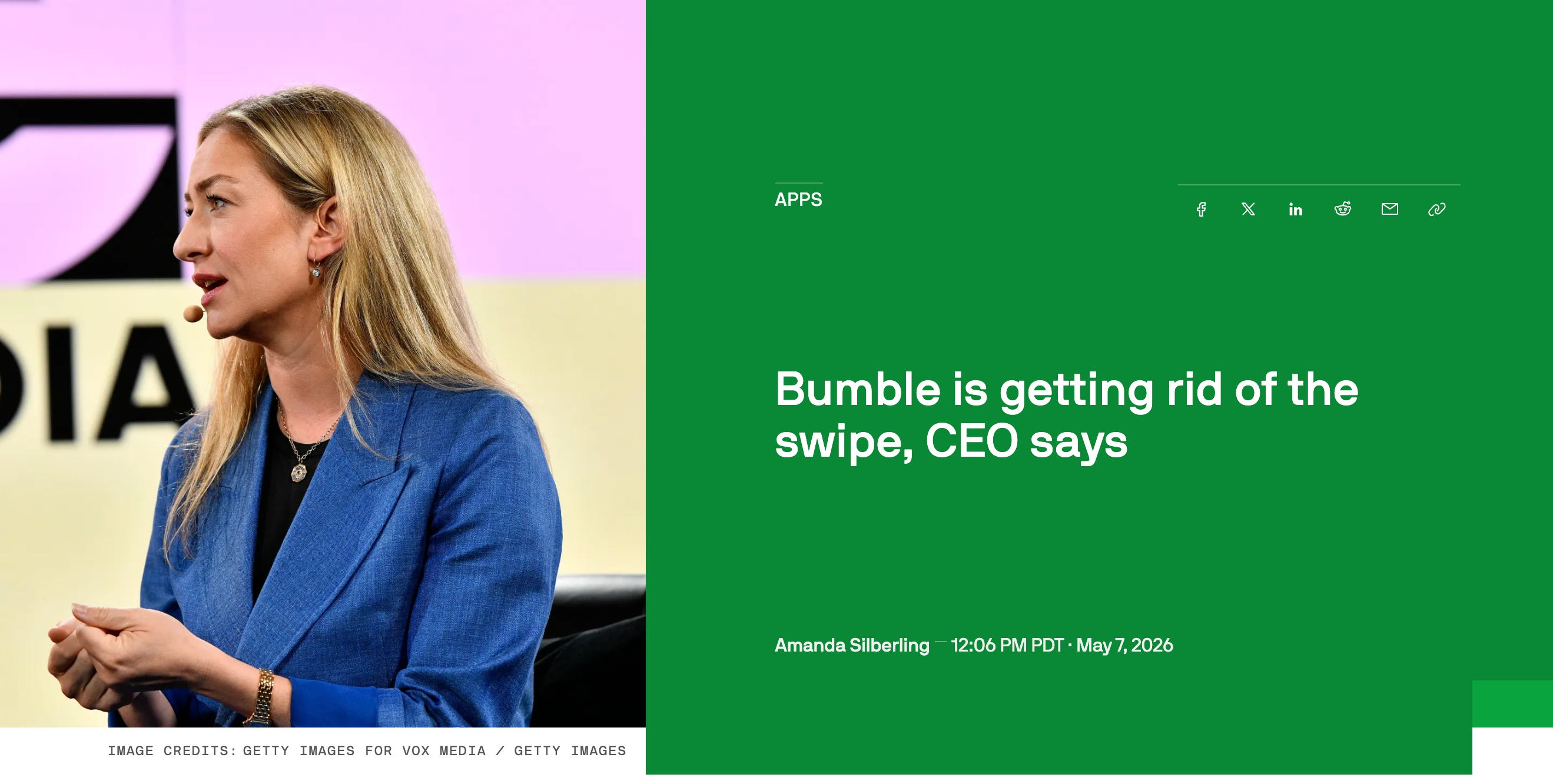
Bumble is getting rid of the swipe, CEO says
TechCrunch | ~4-min read
Whitney Wolfe Herd confirmed Bumble will scrap swiping entirely later this year, calling it “revolutionary for the category” without saying what replaces it. Paid users fell 21% in Q1 to 3.2 million. Bumble is building an AI dating assistant called Bee, and Wolfe Herd has floated more extreme ideas like personal AI bots that date other AI bots on your behalf, even though Gen Z is trending negative on in-your-face AI features.
My take: The swipe built the entire 2010s dating app economy and Bumble is calling it dead. The harder question is whether AI matchmaking solves the actual problem, which is that young people are exhausted by being optimized in their love lives. Convenience is not what’s missing tbh...
who’s winning the business of ai
Anthropic beats OpenAI on business adoption
Ramp | ~6-min read
Anthropic just passed OpenAI in paid business adoption for the first time, hitting 34.4% of businesses in April versus OpenAI’s 32.3%. Anthropic quadrupled its business adoption over the last year while OpenAI grew 0.3%. Overall business AI adoption crossed 50.6%, with Claude Code as the engine behind much of Anthropic’s growth.
My take: A year ago, suggesting Claude would overtake ChatGPT in the enterprise sounded like a stretch.
openai and the voice cloning gray market
OpenAI quietly bought a voice-cloning startup
The New York Times | ~6-min read
OpenAI acquired Weights.gg, a small voice-cloning startup whose Replay catalog hosted models of Taylor Swift, Samuel L. Jackson, Donald Trump, Joe Biden, members of Blackpink and more. The team has been dispersed across OpenAI, the consumer service was wound down on April 1, and OpenAI is still publicly maintaining that its own Voice Engine is too risky for general release.
My take: This was a takedown disguised as an acquisition, days after Swift filed trademarks on her own voice. With an OpenAI IPO on the horizon, cleaning up the celebrity voice catalog before it shows up in a discovery filing is just hygiene. Worth watching how aggressively the rest of the labs move next.
the agent shopper era
Traditional marketing doesn’t work on AI shopping agents
Harvard Business Review | ~7-min read
Researchers from Bayes Business School and King’s College London tested eight classic e-commerce persuasion tactics across four models in thousands of simulated shopping rounds. Only star ratings consistently moved choice in the expected direction. Price reliably reduced selection. Scarcity, countdown timers, strike-through pricing, vouchers, and bundles produced unstable or backwards effects, with more advanced reasoning models often appearing skeptical of overt persuasion.
My take: Treat AI agents as a separate audience segment, the same way you’d treat any other distinct buyer.
As AI reshapes discovery, the checkout may become the brand experience
The Drum | ~5-min read
As AI compresses the journey, the checkout becomes one of the last surfaces brands fully own. Rokt research shows 73% of consumers find joy at the online checkout and 74% would rather see no offer at all than an irrelevant one. eMarketer projects AI platform-driven e-commerce will hit $20.9 billion in 2026. Tails.com saw a 153% conversion lift by refining checkout relevance instead of piling on promotional clutter.
My take: If discovery is moving into ChatGPT, then everything after the click matters more. Order confirmation pages and post-purchase moments are about to do real brand-building work, and most teams have not given them a thought in years.
the cost vs growth choice for cmos
Marketing in the AI era: to matter more or cost less
PwC | ~8-min read
PwC research with the ANA shows leading marketers deliver 79% greater total shareholder value than their peers. A strategy of reinvesting AI efficiency gains into greater effectiveness is more than 2x more profitable than one focused on short-term savings. CMOs face a clear choice: use AI to manage marketing costs, or use it to drive long-term growth. As one global energy exec put it, “Efficiency is the easy part. Real value comes when AI changes how we create and compete.”
My take: Every CFO this year is going to look at AI and see a chance to cut.
Why AI makes brand leadership more important
MarTech | ~7-min read
Only 49% of Fortune 500 companies still have someone with the CMO title, down from 55% the year before. More than one in five F500 firms changed their marketing leadership in the past 12 months. The author argues this is exactly the wrong direction. As more buyers use AI to find products, promotional spend stops driving sales and AI starts looking for meaning. The brands without a clear brand steward risk becoming invisible inside the models.
My take: AI cannot see your jingle. It cannot see your discount. It can only see what your brand is known for and how often it gets cited as the answer. I think the companies that no longer have the CMO role are about to find out the hard way.
ai got faster, the org chart did not
AI made marketers faster, but organizations stayed the same
MarTech | ~6-min read
Melissa Reeve uses a composite marketing team called Meridian Digital to make the point: turning a Monday blog post into a Tuesday email used to take four days. With AI, individual tasks got 30% faster, but the newsletter still takes four days because the handoffs, waits, and approvals are still human. Real impact only comes when someone is asked to own the work of connecting specializations across the team, which she calls coordinated progress.
My take: This is one of the most useful framings I’ve read on agentic AI. Individual productivity gains do not change how an org actually ships. If your team is faster but your timelines look the same, you have a workflow problem dressed up as a tooling problem.
the programmatic buying showdown
Marketers put up guardrails as AI agents reshape programmatic buying
Digiday | ~5-min read
At Digiday’s Programmatic Marketing Summit, agency execs admitted they don’t fully trust AI agents to run ad buys yet. The fear: a hallucinated CPM that blows a quarter’s budget in a weekend, with the agency holding the bag. The IAB Tech Lab launched the Programmatic Governance Council in April with WPP, Disney, Magnite, Yahoo, Amazon Ads, and The Trade Desk to set transparency standards. For now, humans stay at the wheel.
My take: The agencies that figure out the governance layer for agentic media buying will be in a much stronger position than the ones who either rush in or sit it out.
design, type, and the look of ai
What new AI design tools mean for brand typography
Fast Company | ~6-min read
Tools like Claude Design make design faster, easier, and cheaper. They also push brands toward what’s legible, familiar, and proven, which is another way of saying generic. Typography is brand infrastructure that has to work across every product, platform, and language. If AI pushes more brands toward the same safe defaults, the brands that invest in real typographic distinction stand out faster, with less media spend.
My take: Generic is more expensive than it looks. If your brand is suddenly easier to imitate, you’re paying for differentiation somewhere else, usually in paid media. Spend the money on the type system once instead.
👩💻 thought-leader highlights
Alessandra Ram - “The Sad Wives of AI: Labor Market Story”
A WIRED investigation examining how the AI boom affects relationships, particularly women partnered with Bay Area AI professionals. Ram frames this as a labor market issue rather than lifestyle journalism, incorporating perspectives from labor economists and family therapists. The piece deliberately interviews only women, noting that male AI leaders already dominate media platforms, and explores how obsession with AI work reshapes domestic life and family dynamics.
Avery Akkineni - “The gap between using AI tools and actually building with AI code”
Highlights the critical difference between chatting with ChatGPT, Claude, or Gemini for hours versus building with Claude Code. Recommends “Couch to 5K for AI”- a free 10-minute daily program by Lenny Rachitsky and Hilary Gridley- to help professionals transition from passive AI consumers to active builders over 30 days. Key insight: lowering activation energy through incremental steps builds genuine AI development muscle.
Josh Blyskal - “Time-to-Citation for AI Answer Engines”
Analyzed ~900 newly published marketing pages to establish first-ever benchmarks for content citations in ChatGPT and Claude. Key findings: median citation time is 6.81 days, with 75th percentile at 18.68 days and 90th at 37.10 days. Content cited within 6 days outperforms average; content beyond 37 days likely has technical issues like blocked crawlers or robots.txt restrictions. Establishes critical AEO (Answer Engine Optimization) performance indicators.
Robyn Cohen - “Women’s underrepresentation in AI adoption”
Examines the 25% gap in AI adoption between women and men, with women representing only 31% of Claude users and 27% of ChatGPT downloads, despite facing 1.6x higher layoff likelihood. Contrasts Reese Witherspoon’s encouragement for women to learn AI with New York Magazine’s critique of “girlbossification of AI.” Cohen argues that unlike Web 2.0 requiring coding skills, AI’s natural language interfaces offer unprecedented accessibility—making exclusion from this technological shift particularly concerning.
Anna Wojciechowska - “Why Your Company’s AI Rollout Is Failing (And What Actually Works)”
Reveals three critical mistakes in AI implementation: starting with the tool instead of the problem, training executives instead of frontline workers, and measuring adoption over impact. Of six observed rollouts, four failed despite good funding and tools. What works: focus narrowly on one team and workflow, involve actual users in shaping implementation, and track real outcomes like response time and error rates rather than usage statistics. Key takeaway: successful AI companies listen to workers, not just buy better tools.
Tayla Burrell - “You can literally just vibe code things (here’s how with Claude Code)”
Outlines five-step process: create your vision, develop a PRD, build with Claude Code using frontend-design skill and plan mode, deploy via GitHub and Vercel, then iterate. Democratizes software creation by emphasizing that visualization and clear ideation matter more than coding ability, encouraging low-stakes experimentation for creative thinkers.
🛠️ latest ai + marketing tools
Alexa for Shopping
Amazon retired Rufus and replaced it with a unified AI shopping assistant now living in the main search bar. Available to all U.S. customers, no Prime required. Knows your order history, sets price alerts, reorders essentials, and uses “Buy for Me” to complete purchases on other sites on your behalf.
Claude for Small Business
Anthropic launched a toggle-install package of 15 pre-built workflows and connectors for QuickBooks, PayPal, HubSpot, Canva, Docusign, and Microsoft 365. Covers payroll planning, invoice chasing, month-end close, and campaign creation inside Claude Cowork, with human approval required before anything sends or pays. Paired with a free 10-city U.S. workshop tour, 100 small business leaders per stop, each getting a free month of Claude Max.
ChatGPT personal finance
Pro users in the U.S. can now connect bank accounts, credit cards, and investments via Plaid and ask questions grounded in their actual financial picture. A live dashboard tracks spending, subscriptions, portfolio performance, and upcoming payments. ChatGPT can’t move money or see full account numbers. Intuit support coming soon.
Codex on mobile
OpenAI brought Codex to iOS and Android, letting developers monitor tasks, review diffs, approve commands, and kick off new work from their phones while Codex runs on their desktop. Available in preview to all plans including free. Files, credentials, and permissions stay on the host machine; the phone is the remote control.
Gemini Intelligence for Android
Google announced Gemini Intelligence at The Android Show, repositioning Android as an “intelligence system” rather than an operating system. New features include multi-step app automation, smarter Chrome browsing with summarization and form-filling, Rambler for turning voice notes into polished messages, and natural-language widget creation. Rolling out to Samsung Galaxy and Pixel phones first, summer 2026.
Runway Agent
Runway launched an AI creative partner that develops and produces a finished video entirely through conversation. Describe what you need, refine direction together, and generate it in one session without touching a timeline or switching tools.
Higgsfield Supercomputer
Higgsfield launched a cloud-native AI agent stack for end-to-end automated media production, on the heels of their viral 23-minute AI sci-fi pilot produced in 96 hours. The agent orchestrates scriptwriting, character design, video generation, and quality checking in a recursive loop. Higgsfield reached a $1.3B valuation and serves 22 million users, generating 4 million videos per day.
Cursor Composer 2.5
Cursor’s most capable in-house coding model, trained on 25x more synthetic tasks and built for long, complex sessions. Matches Claude Opus 4.7 and GPT-5.5 on SWE-Bench at roughly one-tenth the cost ($0.50/M input tokens standard). Cursor is also training an even larger model with SpaceX’s Colossus 2.
Krea 2
Krea’s second generation brings a major leap in image quality, real-time generation speed, and creative control. Enhanced style transfer, sharper product renders, and tighter prompt adherence position it as a professional creative tool for designers and marketers, not just a consumer image generator.
Step Image Edit 2
Stepfun’s new image editing model makes targeted changes to existing images without degrading quality. Designed for production workflows where localized edits matter: swapping backgrounds, adjusting product details, or refining brand assets at scale.
Alexa AI podcasts
Amazon launched AI-generated audio episodes in the Alexa ecosystem, giving users personalized briefings, news recaps, and topic deep-dives through Alexa-enabled devices. Positions voice assistants as audio creation and delivery surfaces, not just playback devices.
Hint (Martha Stewart’s AI home startup)
Martha Stewart co-founded Hint, an AI home management platform that flags issues like expiring insurance, leaky ceilings, and high utility bills before they become problems. Raised $10M from Slow Ventures. Stewart helped design the visual language and wrote guides the product pulls from directly. Launching on desktop and iOS this summer.
Lovable Skills
Lovable launched Skills, a system for saving reusable instructions that Lovable applies automatically whenever a matching task comes up. Write once: your launch checklist, brand voice, preferred component structure. Team workspaces share skills across every project automatically, so no one has to explain the same thing twice.
💼 cool ai + marketing jobs
Ramp - Agentic Operator, Growth Marketing
Intuit - AI Marketing Manager, Marketing Futures
Goodie AI - Growth Marketing Lead
OpenAI - ChatGPT Research Product Marketing Manager
Google - AI Solution Architect, YouTube Marketing
Reply anytime and let me know:
Topics you’d like covered in future weeks
Sections you love or could do without
Questions about AI, marketing, or anything else
Love y’all,
Carley