

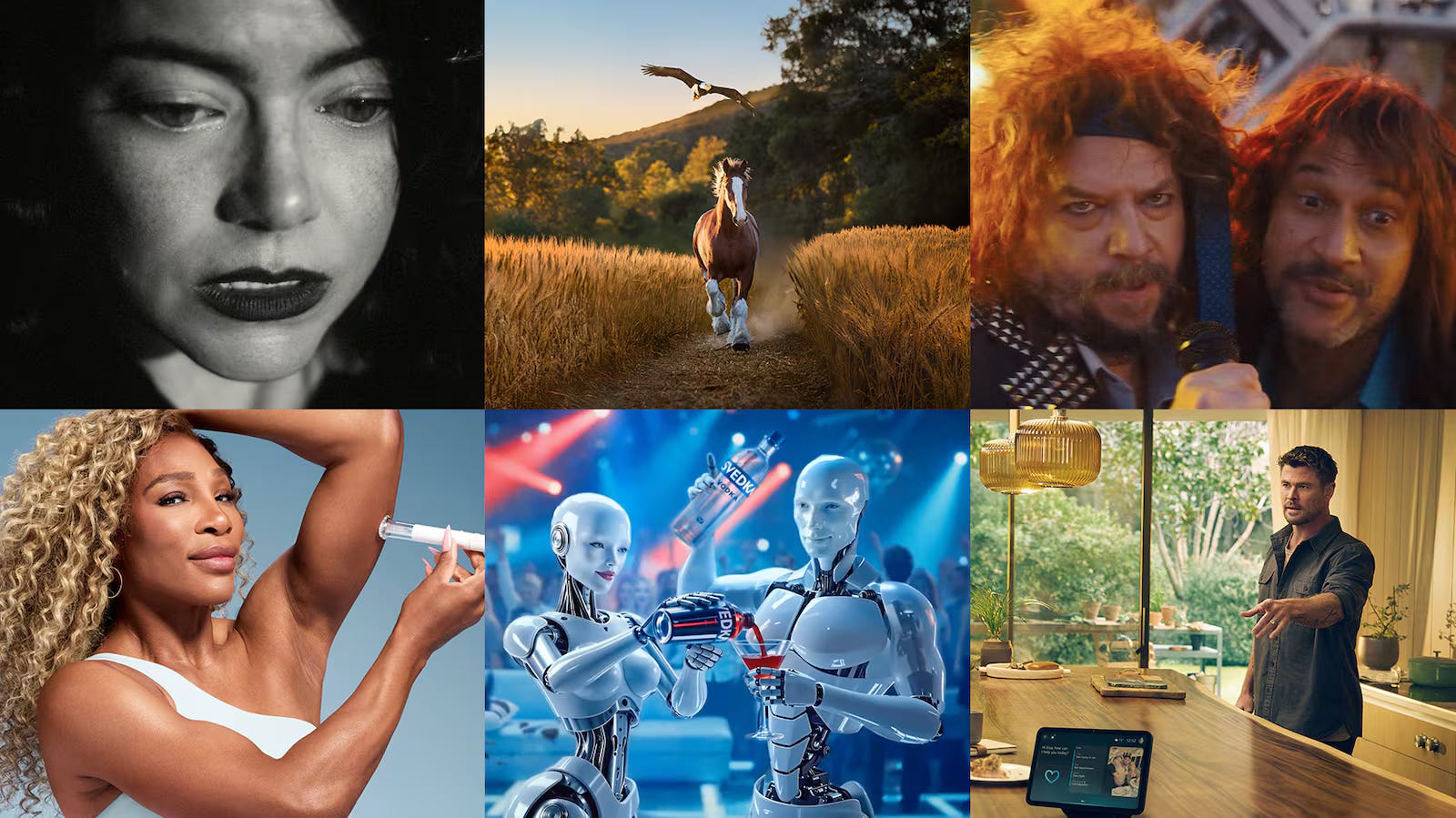
🎯 what you need to know this week in ai + marketing in 15 seconds:
• The AI Super Bowl moment happened - Anthropic, OpenAI, Genspark showed up. Every AI company seemed to be asking for trust, not demanding attention. They’re negotiating acceptance, not flexing power (Multiple sources)
• AI could unlock $30B for marketers - if we fix measurement first - without cleaner data and shared definitions of performance, AI just accelerates messy systems (MarTech)
• Sam Altman called Anthropic’s Super Bowl ad “dishonest” - CEO rivalry playing out in real time. The ad was a joke that exaggerated awkwardness of talking to AI. But sensitivity in this space is high (Twitter/X)
• ChatGPT ads launched - OpenAI’s first live ad test shows sponsored messages to Free/Go users. Anthropic responded with Super Bowl ads mocking OpenAI: “Ads are coming to AI. But not to Claude” (OpenAI)
• Claude Opus 4.6 released - Agent teams for parallel tasks, Claude in PowerPoint. Outperforms GPT-5.2 on knowledge work benchmarks (Anthropic)
• OpenAI launched Frontier - enterprise platform for building fleets of AI agents that plug into CRMs, data warehouses, internal apps. Early adopters: Uber, State Farm, Intuit (OpenAI)
• “The rise of the professional vibe coder” - Elena Verna @ Lovable hired someone to rapidly build products and campaigns using AI. This hybrid PM-designer-marketer role becoming a full profession (Elena Verna)
🗞️ top ai + marketing news
measurement, money, and where AI actually pays off
AI could unlock $30B for marketers — if we fix measurement first
MarTech | ~4 min read
AI promises massive efficiency gains, but this piece argues the real unlock is fixing attribution and measurement. Without cleaner data and shared definitions of performance, AI just accelerates messy systems.
My take: This feels right. Most marketing teams don’t have an AI problem. They have a measuring the impact problem.
In Q1, marketers pivot to spending backed by AI and measurement
Digiday | ~5 min read
Marketers are tightening budgets and reallocating toward tools that show measurable AI impact, especially performance and analytics. Experimental AI projects are giving way to spend tied directly to ROI.
My take: The vibe shift is real, peeps. “AI innovation” is out. “Prove it” is in.
the AI super bowl
Genspark leverages AI for fast-turnaround Super Bowl spot
Adweek | ~4 min read
Genspark used AI to dramatically compress production timelines for its Super Bowl debut, positioning speed itself as the differentiator.
Super Bowl 60 AI ads: Svedka, Anthropic and more
TechCrunch | ~5 min read
Breakdown of how AI companies showed up on the biggest ad stage of the year, from Svedka to Anthropic.
OpenAI’s Super Bowl spot: the AI Bowl moment
Marketing Brew | ~4 min read
Covers OpenAI’s long-awaited Super Bowl debut and the broader “AI Bowl” narrative among competing platforms.
Exclusive: Inside OpenAI’s Super Bowl ad playbook
Fast Company | ~6 min read
Behind-the-scenes look at OpenAI’s strategy and messaging decisions heading into the game.
AI chatbots rank top Super Bowl ads — and leave out Big Tech
Adweek | ~4 min read
Chatbots were asked to rank the best ads. The results were interesting - and revealing - especially in how AI systems evaluate their own ecosystem.
Why is every AI Super Bowl ad asking for permission?
Muse by Clios | ~3 min read
Observes a clear theme: AI brands framing themselves carefully, even cautiously, instead of flexing dominance.
AI brands at the Super Bowl
Ad Age | ~5 min read
Recap of how Anthropic, Genspark, Meta, OpenAI and Wix approached their spots.
2026 Super Bowl ad trends, including AI
Ad Age | ~5 min read
Zooms out on larger themes shaping this year’s game.
Altman vs Anthropic in the Super Bowl spotlight
CNBC | ~4 min read
Focuses on the emerging rivalry narrative and the stakes of brand positioning.
ChatGPT ads spark agency interest
Ad Age | ~4 min read
Agencies are seeing AI companies as new, serious brand advertisers - not just product marketers.
AI, crypto, and the Super Bowl moment
Ad Age | ~4 min read
Explores how AI brands are filling the cultural-ad spotlight crypto once occupied.
My take (longer, because there is a lottttt):
This felt like the first Super Bowl where AI companies weren’t hovering around the edge of culture. They were in the middle of it.
Anthropic leaned into humor in a way that surprised people. The ad didn’t try to explain the tech. It made a joke about the awkwardness of talking to AI in the first place, and it trusted the audience to get it. That confidence came through. It felt like a brand that knows exactly how it wants to be perceived.
OpenAI’s spot was more controlled. Clean, careful, clearly thought through. You can sense the weight they’re carrying as the most recognizable name in AI. When you’re that visible, you don’t get to be scrappy. You get to be responsible. The ad reflected that.
Then Sam Altman tweeted that Anthropic’s ad was funny but “clearly dishonest.” Which, yes. It was a joke. Of course it exaggerated. That’s what ads do. But the fact that the CEO stepped in publicly shows how sensitive this space is right now. Brand rivalry is no longer abstract. It’s playing out in real time (and tbd Claude is winning in my opinion on product, trust, safety, and now humor (and reading the room…cough Sam Altman)).
What I found most interesting wasn’t which ad ranked higher or who had more impressions. It was the tone across the board. Almost every AI company seemed to be asking for trust. Not demanding attention. Not flexing power. Asking for permission to be part of people’s lives.
That’s a very different posture than tech had a few years ago. And it tells you where AI sits culturally. It’s powerful, but it’s still negotiating acceptance.
If anything, the real story of this Super Bowl wasn’t that AI showed up. It’s that AI showed up trying to behave…but don’t get me started on the Ring ad…you’re not getting us with mass surveillance acting as a cute pet finder. Behaving doesn’t mean pulling a fast one on us.
creators, distribution, and who gets paid
Google and Microsoft pay creators $500,000+ to promote AI
CNBC | ~4 min read
Big tech is cutting serious checks to influencers to normalize AI products. Creator marketing is now core AI distribution strategy.
My take: AI companies don’t just need ads. They need social proof.
enterprise friction and leadership
Microsoft’s pivotal AI product hits roadblocks
The Wall Street Journal | ~6 min read
Details challenges facing one of Microsoft’s flagship AI initiatives, underscoring how hard enterprise AI rollouts still are.
My take: Consumer hype does not equal enterprise adoption.
Find your AI leadership superpower
Fast Company | ~4 min read
Encourages leaders to define how they uniquely contribute in AI-driven orgs, rather than trying to be the most technical person in the room.
My take: The leaders who win here won’t be the most technical. They’ll be the clearest thinkers.
👩💻 linkedin highlights
Kim Caldbeck – “I was a ChatGPT loyalist. Claude Cowork just changed that”
Kim describes how Anthropic’s Cowork integrates directly with Gmail, Docs, Slack and Calendar to handle tasks end to end. It summarized her onboarding docs, created calendar invites for her kids’ sports schedule and redesigned slides while she kept working, so she still writes with ChatGPT but now relies on Claude for workflow automation.
Elena Verna – “The rise of the professional vibe coder (a new AI‑era job)”
Elena says she hired a “vibe coder” to rapidly build products, campaigns and internal tools using AI and that this hybrid PM‑designer‑marketer role is poised to become a full‑time profession as companies want experiments spun up faster.
“I think we’re watching a new profession emerge: full‑time vibe coder” - Elena Verna, Head of Growth @ Lovable
Brendan Hufford – “Content marketing is being dismantled as we speak”
Brendan argues content marketing’s decline isn’t due to AI but to outdated tactics like cold outbound, gated PDFs and high‑volume AI content that erode trust. He outlines three phases of change: the 2025 “volume trap,” today’s “credibility collapse” where only lived experience and proof resonate, and an imminent “unbundling” where content becomes an organization‑wide system focused on one point of view.
Ina Toncheva – “How I switched from ChatGPT to Claude (step‑by‑step)”
Ina shares her migration plan: export ChatGPT data, save custom instructions and top prompts, subscribe to Claude Pro, set up memory and recreate custom GPTs using Claude Skills. She says you don’t lose context but shed baggage and that Claude writes more naturally, though she still uses ChatGPT for specialized research.
Ina Toncheva – “A marketer’s guide to Claude”
Ina highlights Claude’s key marketing functions - writing with brand guidelines built in, ad platform integrations, competitor research, bulk link updates via Claude Code and Projects for campaign context. After three years of ChatGPT use, she prefers Claude for better writing and asks marketers which of these functions they find most valuable.
🛠️ latest ai + marketing tools
ChatGPT Ads
OpenAI launched its first live ad test in ChatGPT, showing sponsored messages to Free and Go tier users. Ads appear below responses, clearly labeled, and are tailored based on conversation topics and past chats. Plus/Pro/Business/Enterprise remain ad-free. The move prompted Anthropic to run Super Bowl ads mocking OpenAI with the tagline: “Ads are coming to AI. But not to Claude.”
Canva Brand Kit + AI Assistants
Canva expanded its MCP integration so ChatGPT and Claude can now generate designs using your Brand Kit - automatically applying your colors, fonts, and logos. The Canva MCP Server has created over 12 million designs across ChatGPT, Claude, and Microsoft Copilot.
Claude Opus 4.6
Anthropic released Opus 4.6 with “agent teams” for parallel task execution, and Claude in PowerPoint as a research preview. The model outperforms GPT-5.2 on the GDPval-AA knowledge work benchmark. Anthropic’s red team found 500+ zero-day vulnerabilities in open-source code before launch.
OpenAI Frontier
OpenAI launched Frontier, an enterprise platform for building and managing fleets of AI agents that plug into existing business systems. It connects data warehouses, CRMs, and internal apps to give AI “coworkers” shared context and permissions. Early adopters include Uber, State Farm, Intuit, and Oracle.
OpenAI GPT-5.3-Codex
OpenAI released GPT-5.3-Codex, its most capable agentic coding model - 25% faster than its predecessor and the first classified “high capability” for cybersecurity. The model helped debug its own training and deployment. Available now in Codex app/CLI/IDE; API access coming soon.
Anthropic Cowork Plugins
Anthropic open-sourced 11 plugins for Cowork covering sales, finance, legal, marketing, customer support, and product management. Each bundles skills, connectors, and sub-agents to make Claude work like a domain expert.
Snowflake + OpenAI Partnership
Snowflake and OpenAI signed a $200M deal to bring GPT-5.2 directly into Snowflake Cortex AI and Snowflake Intelligence. The integration lets 12,600+ enterprise customers build AI agents on their data without moving it outside Snowflake’s governed environment.
💼 cool ai + marketing jobs
Anthropic - Technical Product Marketing Lead
Sendbird - AI-First Full Stack Marketer
Listen Labs - Growth Lead, Acquisition
HubSpot - Senior Marketer, AI Partnerships
Stripe - Product Marketing Manager, Agentic Commerce
Higgsfield AI - AI Educator - Enterprise
❓ you made it to the poll!
Thanks for being here for the first AI + Marketing Weekly Substack send!
I want to continue make sure this newsletter is useful for you. Hit reply anytime and let me know:
Topics you’d like covered in future weeks
Sections you love or could do without
Questions about AI, marketing, or anything else
I read every reply and use them to shape what I write.
Love y’all,
Carley